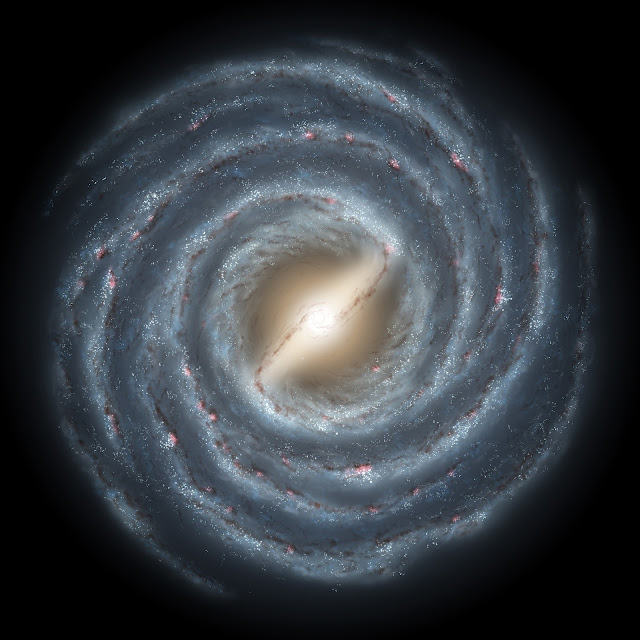
This artist's rendering shows a view of our own Milky Way Galaxy and its central bar as it might appear if viewed from above. An arrow indicates the location of our Sun. Astronomers have concluded for many years that our galaxy harbors a stellar bar, though its presence has been inferred indirectly. Our vantage point within the disk of the galaxy makes it difficult to accurately determine the size and shape of this bar and surrounding spiral arms. New observations by the GLIMPSE legacy team with NASA's Spitzer Space Telescope indicate that the bar-shaped collection of old stars at the center of our galaxy may be longer, and at a different orientation, than previously believed. The newly-deduced size and angle of the bar are shown relative to our Sun's location. Our Milky Way galaxy may appear to be very different from an ordinary spiral galaxy. Image Credit: NASA/JPL-Caltech/R. Hurt (SSC) Explanation from: http://www.spitzer.caltech.edu/images/2353-sig05-010a-Milky-Way-Bar
NGC 2207 and IC 2163 are two spiral galaxies in the process of merging. This pair contains a large collection of super bright X-ray objects called "ultraluminous X-ray sources" (ULXs). Astronomers have found evidence for three supernova explosions within this pair in the past 15 years. A new composite image of the system contains X-rays from Chandra (pink) along with optical and infrared data. At this time of year, there are lots of gatherings often decorated with festive lights. When galaxies get together, there is the chance of a spectacular light show as is the case with NGC 2207 and IC 2163 Located about 130 million light years from Earth, in the constellation of Canis Major, this pair of spiral galaxies has been caught in a grazing encounter. NGC 2207 and IC 2163 have hosted three supernova explosions in the past 15 years and have produced one of the most bountiful collections of super bright X-ray lights known. These special objects � known as "ultraluminous X-ray ...
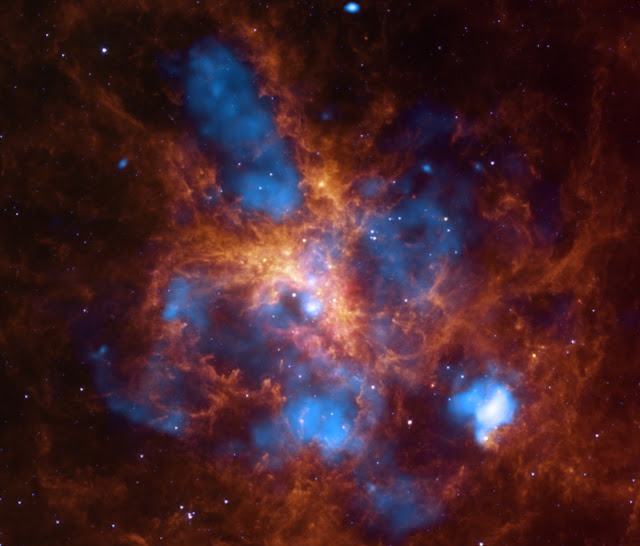
About 2,400 massive stars in the center of 30 Doradus are producing intense radiation and powerful winds as they blow off material. Multimillion-degree gas detected in X-rays (blue) by the Chandra X-ray Observatory comes from shock fronts formed by these stellar winds and by supernova explosions. This hot gas carves out gigantic bubbles in the surrounding cooler gas and dust shown here in infrared emission from the Spitzer Space Telescope (orange). Image Credit: X-ray: NASA/CXC/PSU/L.Townsley et al.; Infrared: NASA/JPL/PSU/L.Townsley et al. Explanation from: http://www.spitzer.caltech.edu/images/4790-sig11-015-30-Doradus-and-The-Growing-Tarantula-Within